
Book Review: Quiet Leadership

Sports leadership is one of the richest domains to learn from.
Unlike most domains, sports (in this case, football) is a profession where literally everyone (your board, your fans, the taxi driver who drove you to the stadium) believes they understand your job better than you do. You manage up to impatient presidents who measure success in trophies, sideways through a dressing room full of multi-millionaires with huge, and downwards to opponents who want your head after a bad run of results.
That’s why extraordinary leaders in football fascinate me a lot. The pressure is relentless, the scrutiny is total, and the margin for error is razor-thin. When someone thrives in that environment for decades, I pay close attention.
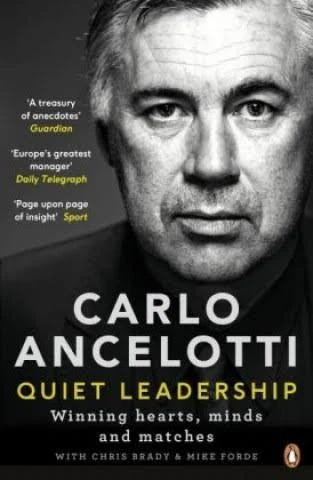
Carlo Ancelotti has thrived for decades. He is the only manager in history to win five Champions League titles. Quiet Leadership, the book on his career, is an exploration of his philosophy of leadership. I recently went through it and came away with a set of lessons that I think go well beyond the touchline.
I’ve spent the last few days reading this book, and I wanted to share the standout moments that really resonated with me.
The Team Is Not Just Everything. It’s the Only Thing.
The leader is mostly not the protagonist of their own story. Every decision, win and growth happens because of the team. The team existed to make that person look good.
In the book, what comes through again and again is how deliberately he places the players above everything else - above his own profile, media pressure or from the noise coming from outside.
He absorbs criticism that could land on players. He shields the dressing room from board-level turbulence. When things go wrong publicly, he tends to be the one standing in front of the cameras taking the heat.
This requires a kind of ego-sublimation that doesn’t come naturally to ambitious people. You have to genuinely believe that your job is to make others shine.
Professionalism Is Non-Negotiable. But So Is Being Human.
When you lead, you need to demand the highest standards from people while simultaneously making them feel genuinely cared for. Most leaders resolve this tension by leaning heavily into one side or the other. Either they’re demanding and cold, or they’re warm and too permissive. This dichotomy has been something that I’ve wrestled with a lot, especially as I was born a people-pleaser.
Players who’ve worked with Ancelloti consistently describe him in two ways. First, he’s someone who demanded total professionalism. He had non-negotiable standards around attitude and effort. But they also describe him as one of the most genuinely human managers they ever worked under. He remembered birthdays and personal details. He noticed when someone was going through something difficult off the pitch. Most conversations he had with the players had nothing to do with football.
I think about this a lot in the context of leading teams. The people who work with you are not productivity units. They have lives, fears and bad weeks (so does a leader). But also, they need to understand that they fit a larger system where they need to do their part and be extremely professional.
Trust Is Built in Ordinary Moments, Not Grand Gestures
One of the interesting themes of the book is how Ancelotti builds trust. This trust accumulates through consistency: he gives players clear roles, he tells them the truth about where they stand, he does what he says he’ll do.
I’ve seen leaders who think trust is built through inspiring talks or high-visibility acts of loyalty. Sometimes it is but, mostly, trust is built in the boring in-between moments - being truthful to your word, when you’re honest about bad news instead of managing someone’s perception of reality (being persuasive instead of manipulative), when you treat the quiet moments with the same integrity as the high-stakes ones.
Ancelotti is consistent. And consistency, over time, is what turns a group of talented individuals into a team that trusts each other under extreme pressure.
Your Data Doesn’t Know Everything
This one sits close to home for me as I’m from a data analysis background. In data science and AI, there’s sometimes a tendency to treat quantitative signals as the final word, as if a number can settle an argument that experience, judgment and context should be having. Ancelotti’s perspective on this is a useful corrective.
He uses data, for sure. But he holds it alongside his own observation, and he’s willing to override it when something doesn’t add up with what he sees in training, in conversations, in the human texture of the team.
His example of a player who might be “underperforming” statistically but who is doing an invisible but essential job, for example, maintaining energy in the dressing room, organising the defensive shape, being the person everyone turns to. The data will never show you these details and not everything that matters can be measured.
Leaders Are Paid for the Hard Calls
Most of a manager’s job is maintenance: making sure things run, problems don’t escalate, people stay aligned. That’s important work, but it’s not what you’re ultimately judged on.
You’re judged on what you do when none of the options are good.
Leaders are paid for extraordinary decision-making. Not for the obvious calls, but for the ones where the stakes are high, the information is incomplete, and the window is narrow. In the context of football, knowing when to make a substitution that changes a match, or which player to trust when the game is on the line.
Building the habit of making those calls clearly, quickly, and without hiding behind process or consensus is one of the harder parts of becoming a better leader.
Recruit for Character First
This might be the most transferable lesson of all for anyone outside football. And one we’ve been practicing at DareData since ever.
Ancelotti is obsessive about the character of the people he brings into a team. Character is important: professionalism, attitude towards the collective and how someone behaves when things are going badly, not when everything is working.
He has said repeatedly that technical brilliance that comes with a toxic personality is a cost, not an asset. The disruption it creates, the trust it erodes, the energy it consumes, all of that compounds over time. He’d rather have a slightly less talented player who is a professional in every sense.
Every time I’ve seen a hiring process focus exclusively on skills and underweight character and culture fit, it’s ended the same way. The person may do fine when the sun is shining. But in the moments that actually define a team, you can’t trust that person anymore.
Manage Up. Seriously.
This one is unglamorous but critical.
Ancelotti operates in environments with powerful, demanding, sometimes irrational owners and presidents. Florentino Pérez is not a passive stakeholder and managing that relationship (setting expectations, communicating clearly, understanding where the real constraints are) is not optional and it’s part of the job.
In any organisation, the ability to manage your relationship with the people above you is a leadership skill that most people systematically underinvest in. Either they assume goodwill without ever earning it deliberately, or they resent the political dimension of the work entirely.
What “Quiet” Actually Means
Reading through the book, I came to realise that quiet in “quiet leadership” doesn’t mean passive or conflict-averse. Ancelotti is direct when he needs to be
But he doesn’t perform leadership. He doesn’t need the room to know he’s the one in charge. The authority is ambient, it comes from how he carries himself, from the consistency of his behaviour, and from the trust he’s accumulated over time.
In environments where everyone is shouting choosing not to shout is itself a kind of radical decision. And yes, you can be a leader without needing to resort to shouting or speaking loudly.