
On Happiness, Productivity and Distraction
If you want to be happy, you seriously need to reduce your social media usage

Human beings weren’t built to process thousands of ruminating thoughts every second. Our brains simply aren’t wired for this constant mental chatter. And even if they could adapt, it would come at the expense of our human experience.
If you’re reading this, I assume you want to be happy. You want to truly cherish the moments of this extremely finite life. At the same time, you want to grow - to become better, stronger, smarter, and more ambitious. You have goals, dreams and hopes for the future, and all those goals, dreams and hopes will require some hard work that will involve some level of stress. How do you marry these two perspectives?
It’s undeniable that the pursuit of these goals naturally requires stress (stress is a natural answer for growth moments). But I've come to realize that stress isn’t the real enemy of your happiness. The actual enemy is our inability to process that stress, simply because our minds are constantly fractured by thousands of daily distractions.
What’s actually killing your joy is a wandering mind, fuelled by the endless distractions surrounding you: your phone, the cat you forgot to feed, the massive project due next week, or the mountain of unread emails and WhatsApp messages. All of these lingering thoughts have one thing in common: you can’t solve them right now.
Think about how many times you’ve mindlessly grabbed your phone today. Think about how often your mind wanders to something completely unrelated to the here and now. Then, consider how rarely you are just present, truly living and cherishing the exact moment you are in.
If you don’t believe me that distractions are killing your happiness, I’ll use some appeal to authority here. Research from Harvard bears this out: when your mind wanders (even if you’re daydreaming about something positive) you’re less happy than when you’re focused.
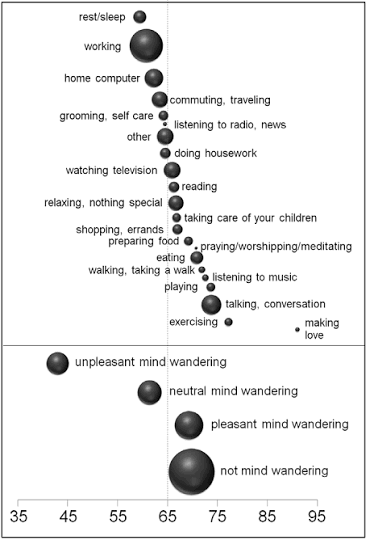
The wandering itself is the problem. You’re not present, which means you’re anxious about the past or pulling yourself into the future, and that tension doesn’t go away just because the dream was pleasant.
And the connection between social media and mind wandering is simple: A lack of attention and focus fuels more daydreaming. The big tech companies exploits this perfectly. You scroll, your brain gets a dopamine hit, and for maybe thirty seconds it feels good. Then it fades and you keep scrolling. After an hour of doomscrolling you don’t feel energized, do you? You feel completely drained, even if you’ve been looking at objectively positive content.
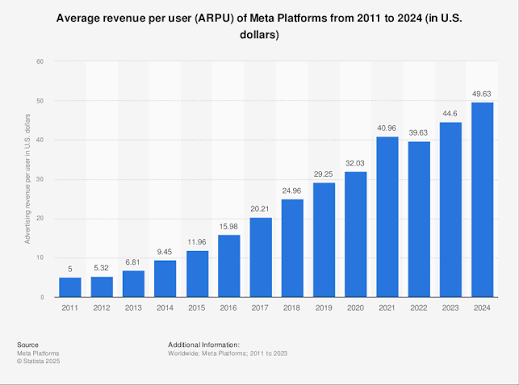
After the dopamine rush fades, you’re left comparing. You’re seeing curated versions of other people’s lives, perfect moments, achievements, vacations, and suddenly your own reality feels thin by comparison.
Wandering about the News
And it’s not just social media. The relentless news cycle preys on your attention and your natural tendency to feel anxious. And as news companies adopt a business model to compete with social media companies, this only gets worse.
You don’t need to become a cave dweller to escape it, but you do need to consume information with intention, and be compassionate with yourself when your focus slips.
In our hyper-connected world, it is incredibly difficult to resist distraction and avoid mindless wandering. But if you let companies hijack your attention, it will unfortunately lead to an unhappy life, regardless of your material, spiritual, or romantic achievements.
You are human, which means your mind will inevitably wander, perhaps 50% of the time. The goal isn’t to stop it, but to notice it. Awareness is half the battle. Acknowledge the drift, gently return your focus to the present, and stop reacting to every ping from your phone. When you reclaim control of your attention, you will undoubtedly be happier.
My Defense Against Distraction: What Worked for Me
As my life gets more “stressful” with more work, a larger company to manage, more things that can go wrong, a newborn coming up, I needed to develop some strategies.
I’ve tried a lot of things, and here’s what worked:
Turned off all phone notifications: This one is non-negotiable. Every buzz will steal your attention. The notifications aren’t urgent. they’re just engineered to feel urgent. I check my phone when I decide to and everyone who knows me knows that if it’s urgent they should call me.
Self-imposed limits on social media: Fifteen minutes a day, maximum. That includes LinkedIn, which is part of my work. Before, I’d open Instagram or scroll LinkedIn and an hour would vanish without me noticing. For LinkedIn (that is part of my work) I go there, post, and leave.
Single-tasking instead of multitasking: This took real practice. I used to think I was efficient juggling three things at once. Multi-tasking is one of the largest sources of unhappiness. I tend to pick one thing at a time, but this one has been the harder one to change.
Moments of intentional thinking: A run without my phone or some time with no distractions at all. Time where thoughts can surface without distraction, but also without the chaos of life.
The Paradox of Planning: Controlled Wandering
“But If I’m always present, how do I plan for the future? How do I think about next quarter, or set five-year goals, or prepare for anything?”
The answer isn’t to never think about the future. It’s to think about it deliberately, not compulsively.
The difference sounds small but it’s everything. Uncontrolled wandering (the kind social media feeds) is your attention being stolen. Controlled wandering is you sitting down with intent and saying, “For the next fifteen minutes, I’m going to think about what comes next.” I do this on Sunday mornings with a notebook and I let my mind roam over the week ahead, jotting down ideas without judging them. This requires training and intent, and takes time to master.
Oh, and on productivity - I’ve noticed that when I deeply focus in one thing at a time, I’m now more productive than ever. Multi-tasking was just a fool’s errand I’ve done to myself.
The Consensus: Why Focus Matters for Happiness
Part of these ideas have come through two different things I’ve been doing (in separate moments, of course :-)):
I’ve been going through the Science of Happiness course from Berkeley - a great, science based course, on how to be more happy.
I’ve just finished the Hyperfocus audiobook by Chris Bailey.
Both arrive at the same conclusion: if your goal is to be happy and you’re living under chronic stress (which most of us are) the only way out is relentless control of your attention.
Your attention is your life. Where it goes, your happiness follows. Social media companies have figured this out and are now competing for ownership of your attention as if it were territory. They’re winning because our brains are wired for distraction, while focus takes actual effort.
So what now? Here are some next steps if you want to follow along with the experiment. Let me know how it worked out for you!
Kill your social media exposure. Turn off notifications on your phone. And commit to one task at a time. All these things will require training and a lot of focus, but I believe you will be a much more happier and productive person on the other end.
Your attention is all you actually have. Spend it like you mean it.