
Raising the Ceiling
We all have ours

Usually when you step into a new role or face a bigger challenge, you may hit a a ceiling. And the uncomfortable part is that you built it yourself throughout your life experience.
I’ve been thinking about this a lot lately. When you move into a new role and suddenly feel incompetent, resist the urge to look backwards.
The skills that made you great before may not transfer, and that's not a failure of your past self, it's just the reality of a higher ceiling. What matters now isn't explaining the gap, it's just closing it fast. The next few months aren't about proving you were a good hire or choice, they're about evolving.
The Ceilings We Build
Ceilings aren’t dramatic, they’re the accumulated weight of past habits, past strengths, past ways of thinking that made you excellent in your last role and also your past life experience.
Management theory has a name for what happens when these ceilings go unaddressed: the haunting Peter Principle. The idea that people get promoted based on how well they perform in their current role, not on whether they have the skills needed for the next one. So they rise, and rise, until they land somewhere they can’t perform.
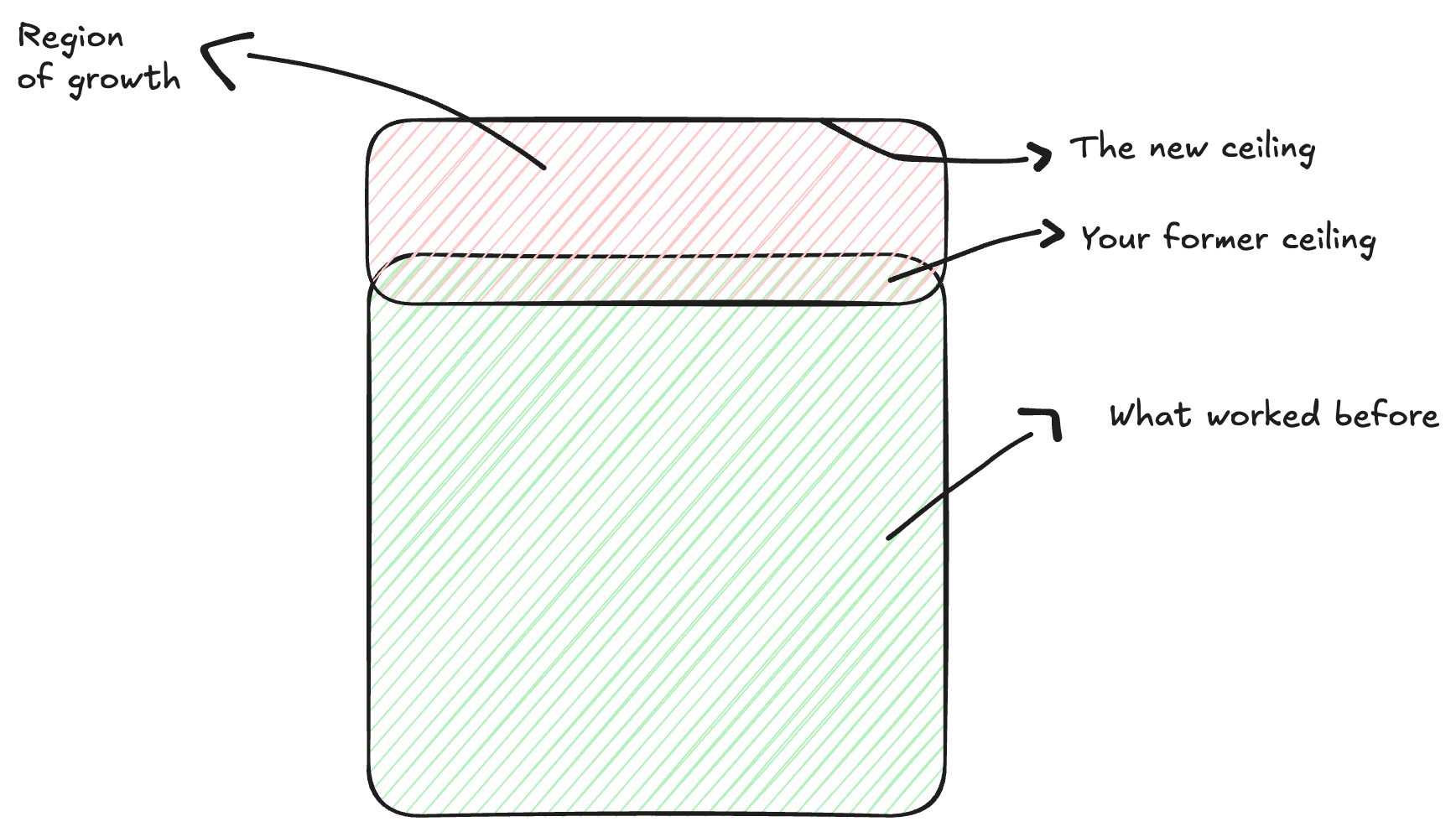
Luckily, the Peter Principle isn't a fatal destiny. We all have a ceiling - for some, that ceiling is running the world's largest companies or countries. For most of us, it sits a little lower, but that ceiling is never fixed. You can raise it. What you can't do is assume the skills that got you to the “What worked before” area will quietly carry you to the next level. They won't and they never do.
Realising that is the first real crack in the ceiling.
The Myth of Automatic Skill Transfer
In this scenario, being genuinely good at something can become a liability. If you were good in another job role, team culture or environment, you will fall into the trap of thinking that that should be enough for your new role.
When you’re an individual contributor, say, a data scientist, you build a very specific kind of competence and technical depth. These are real hard skills and I worked hard to develop them.
None of it transferred the way I expected when I became a manager.
Not because the skills were bad themselves. They were just irrelevant to the new problem. Managing people isn’t a harder version of analysing data. It’s a completely different game, with different rules, and different failure modes. Assuming otherwise is how smart people end up ineffective, they keep playing chess in a room where everyone else is playing poker.
My Own Ceiling: From Code to People
When I made the jump from data scientist to manager, three things bit me harder than I expected.
Patience. I’m not a super patient person. I know this about myself. In a technical role, impatience is sometimes a feature, you push through blockers, you move fast. In management, it tends to backfire. The right answer often needs to arrive at the right moment. People need space to come to their own conclusions and rushing that process poisons it. I’ve had a few times where under stress I would explode or not bring the best to a meeting - understanding this personal flaw was critical to raise my ceiling.
Humour. I default to jokes. It’s how I process stress, defuse tension, connect with people. And for a while, I brought that into my management style without thinking much about it. What I didn’t anticipate was that my team would mirror it back, turning things that needed to be taken seriously into running jokes, following my lead when what the situation actually needed was seriousness and focus. (kudos to Nuno Brás, my cofounder, for bringing me this one). I now learned how to use my humour in the exact right time.
I had to learn to use humour more deliberately, more sparingly. To understand that as a manager, the way you react to things sets the temperature for the entire room.
None of these were fun lessons, they were very personal. But they were the real ceiling, that would make me a worst manager. These unglamorous habits needed to change.
Learning from Someone Who Does This Fast
One of my co-founders at DareData is Rui Miguel Figueiredo. He is the best ceiling raiser I’ve known.
Rui started as an engineer, he is smart, technical, precise. And over the years, I’ve watched him take on more and more responsibility (new domains, new challenges, new contexts) almost on a weekly basis. He doesn’t just adapt, he seems to absorb what a new situation requires and act on it almost immediately. He is very impressive on ceiling raising (Rui Miguel Figueiredo, you should write a post about this ahah)
What I’ve noticed about Rui is that he doesn’t need a long runway to understand what’s being asked of him at the next level. One conversation with me or Nuno, where we are honest about what he needs to develop is usually enough to orient him. He immediately starts moving in the right direction with intention.
That’s rarer than it sounds. Most people spend months clinching to their old approach and avoiding change. Rui doesn’t do that - he maps the ceiling, understands what it’s made of, and starts building the ladder. He is really an inspiration for me as a ceiling raiser.
And this is why startups and scale-ups are such more challenging environments. The ceiling doesn’t just rise when you get promoted, it rises whether you move or not. Stand still, and the bar still moves, and while title stays the same, the job doesn’t.
The Honest Question
Here’s where I’ll leave you.
Just a question worth sitting with: what’s your current ceiling? Can you spot the habit, blind spot or skill gap that you’ve been quietly working around rather than addressing directly and trying to grow?
The ceiling doesn’t disappear because you stop looking at it. You just get better at avoiding it, until the day you can’t.
But none of this works without one thing: openness. The openness to know that critical feedback should land without immediately turning it into a personal attack - you can’t clinch yourself to your old ceiling.
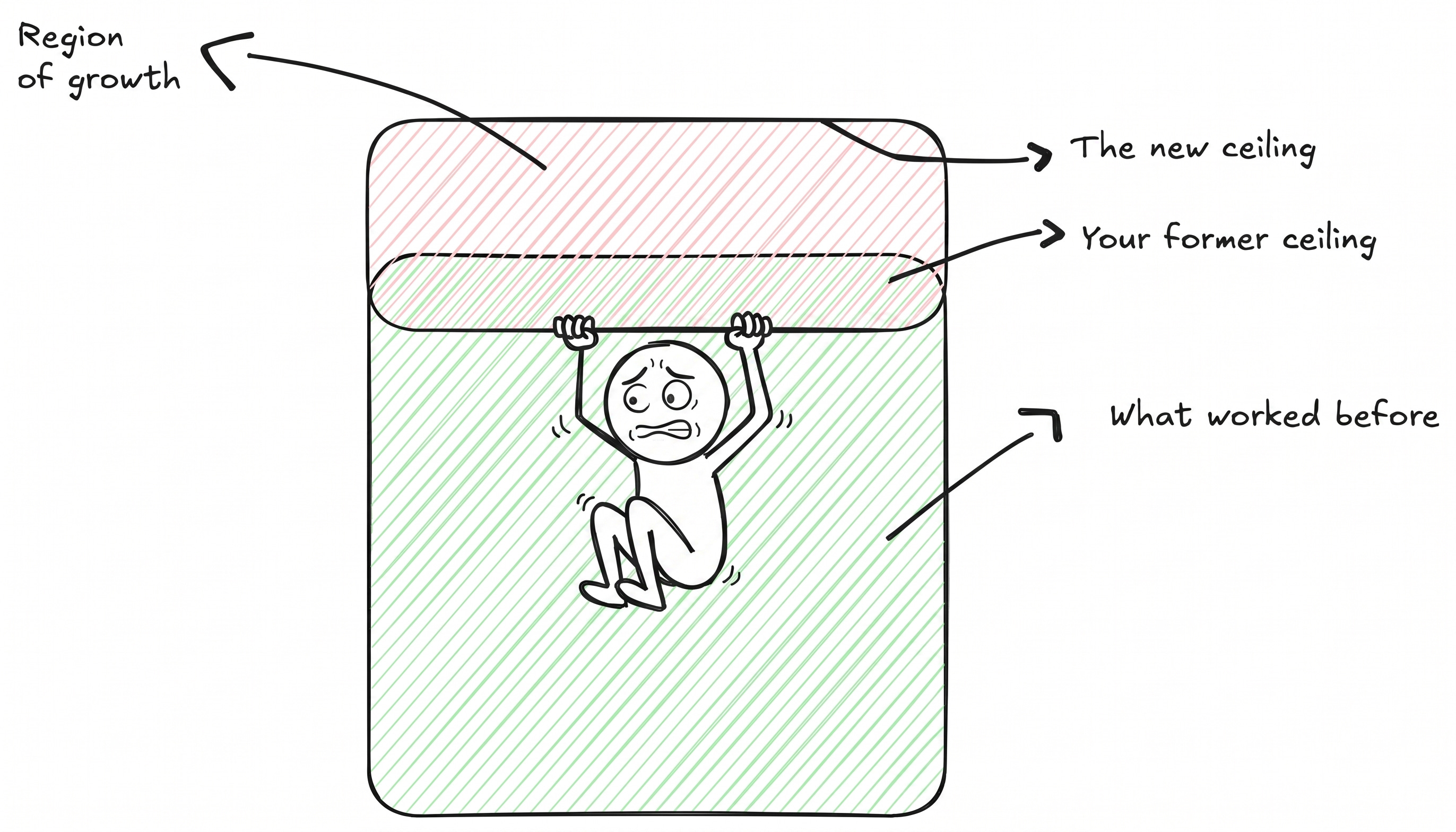
The people who raise their ceilings fastest aren't the ones with the most talent. They're the ones who actively seek someone to challenge them, and then listen.
Find that person and be that person for others. And remember, ceilings look different depending on where you're standing. What growth means in one company, one culture, one team, may look nothing like what it means in the next.
Know what you're growing toward and then go raise the ceiling!
PS: I’m genuinely happy to work with so many ceiling raisers at DareData :-)
— Ivo